GALINA DUBACHEVA
Chargée de recherche (CNRS)
- Imprimer
- Partager
- Partager sur Facebook
- Partager sur LinkedIn
I2BM
Coordonnées
Bâtiment : Nanobio
Bureau : 108
Laboratoire I2BM - Bâtiment NanoBio
DCM - Département de Chimie Moléculaire
UMR CNRS 5250, Université Grenoble Alpes
570 rue de la Chimie, CS 40700
38058 Grenoble cedex 9, France
Galina.Dubacheva@univ-grenoble-alpes.fr
Site web :
Réseaux sociaux :
Thèmes de recherche
OPEN POSITIONS & FUTURE PROJECTS
- We are hiring a PhD candidate within the Marie Skłodowska-Curie Doctoral Network Glycocalyx (Deadline extended to 10 April 2026).
PhD Project "Recognition and self-organisation of the fuzzy glycocalyx – Does binder clustering matter?"
See detailes here: Linkedin, Glycocalyx, apply here: emploi.cnrs, euraxess
CURRENT PROJECTS
- Role of surface chemistry in stimuli-responsive supramolecular interactions
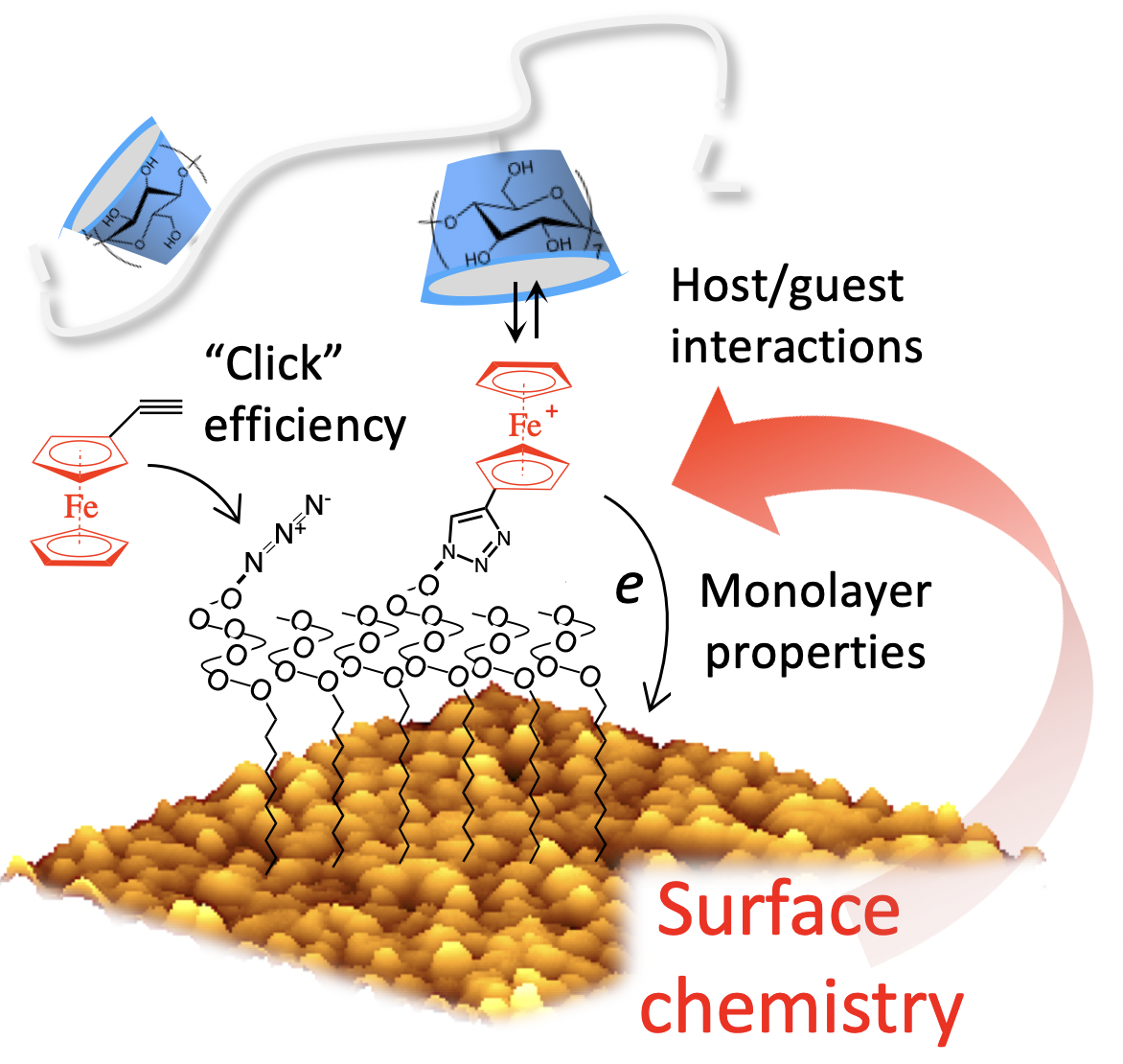
We study host/guest interactions and thermoresponsive polymers on tunable model surfaces to elucidate how interfacial parameters (linkers, diluents, lateral mobility, surface density, and grafting strategy) govern the organization and dynamics of stimuli-responsive assemblies (ANR JCJC “SupraSwitch” 2020-25, PhD & postdoc B. Chabaud)
- D. Kamzabek, B. Le Dé, L. Guérente, F. Miomandre and G. V. Dubacheva, Langmuir, 37, 10971–10978 (2022)
- B. Chabaud, H. Bonnet, R. Lartia, R. Auzély, D. Boturyn, L. Guérente, G. V. Dubacheva, Langmuir, 40, 4646-4660 (2024)
- Bioorthogonal click efficiency at (nano)interfaces
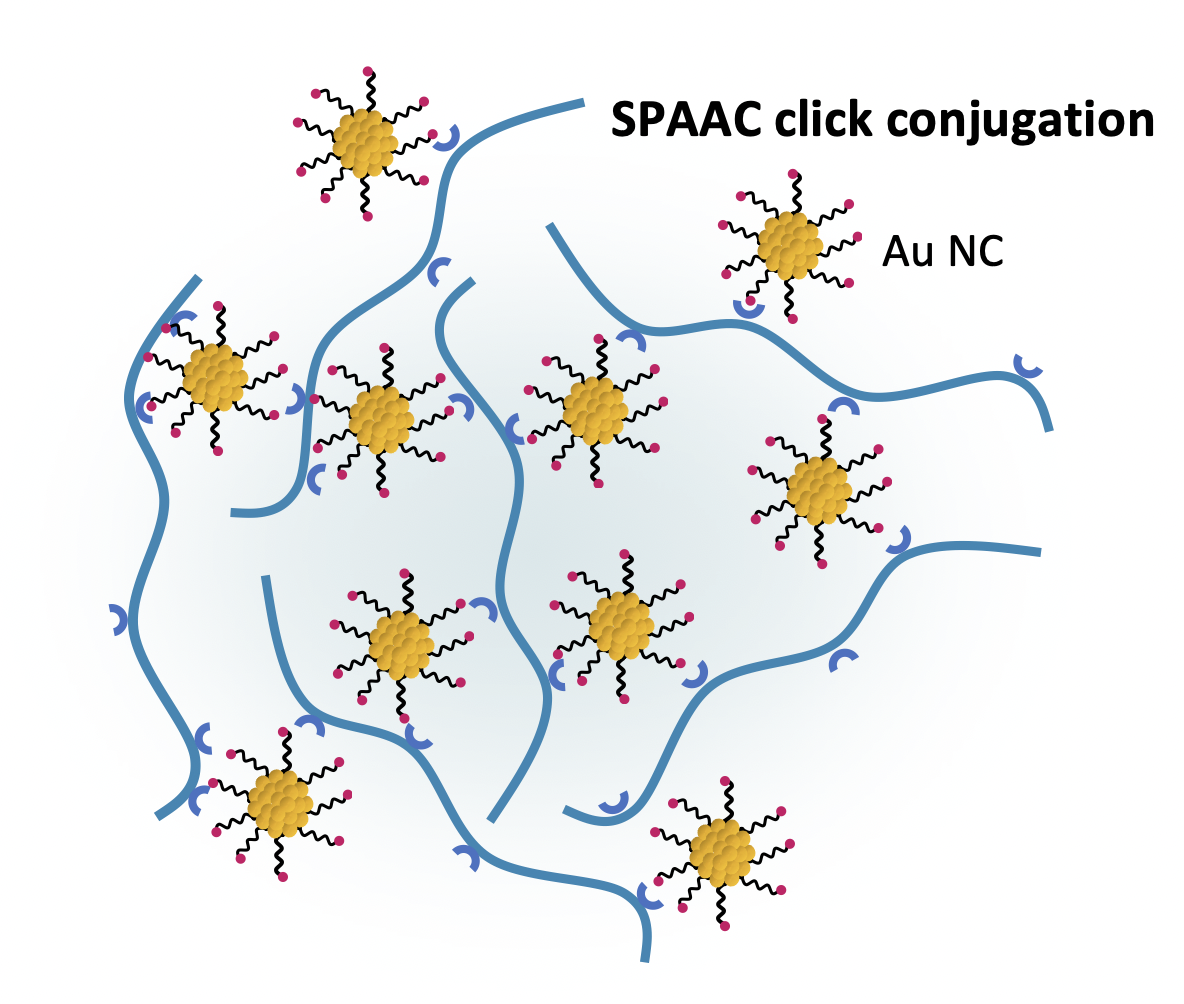
We study specificity and efficiency of SPAAC conjugation between gold nanoclusters and macromolecular scaffolds (polymers, proteins) with a focus on the parameters governing nanocluster functionalization versus their assembly into extended networks (ANR PRC "Sequoia" 2022-26, collab. X. Le Guevel, IAB; PhD F.A. Rezak). In parallel, we investigate the efficiency of SPAAC-mediated polymer grafting onto lipid membranes, together with the influence of clickable-group surface density on SPAAC kinetics (ANR PRC "UtHeal" 2023-27, collab. R. Auzély, CERMAV; postdoc B. Espuche).
- F. A. Rezak, J. G. Coll, G. V. Dubacheva, F. Loiseau, S. Ulrich and X. Le Guével, Chem. Commun., 61, 18697-18700 (2025)
- F. A. Rezak, P. Catal, L. Mantout, F. Da Cruz, D. Boturyn, J.-L. Coll, A. Favier, G. V. Dubacheva and X. Le Guével, Nanoscale Adv. 7, 6929-6940 (2025)
- Biomimetic model surfaces to study multivalent interactions
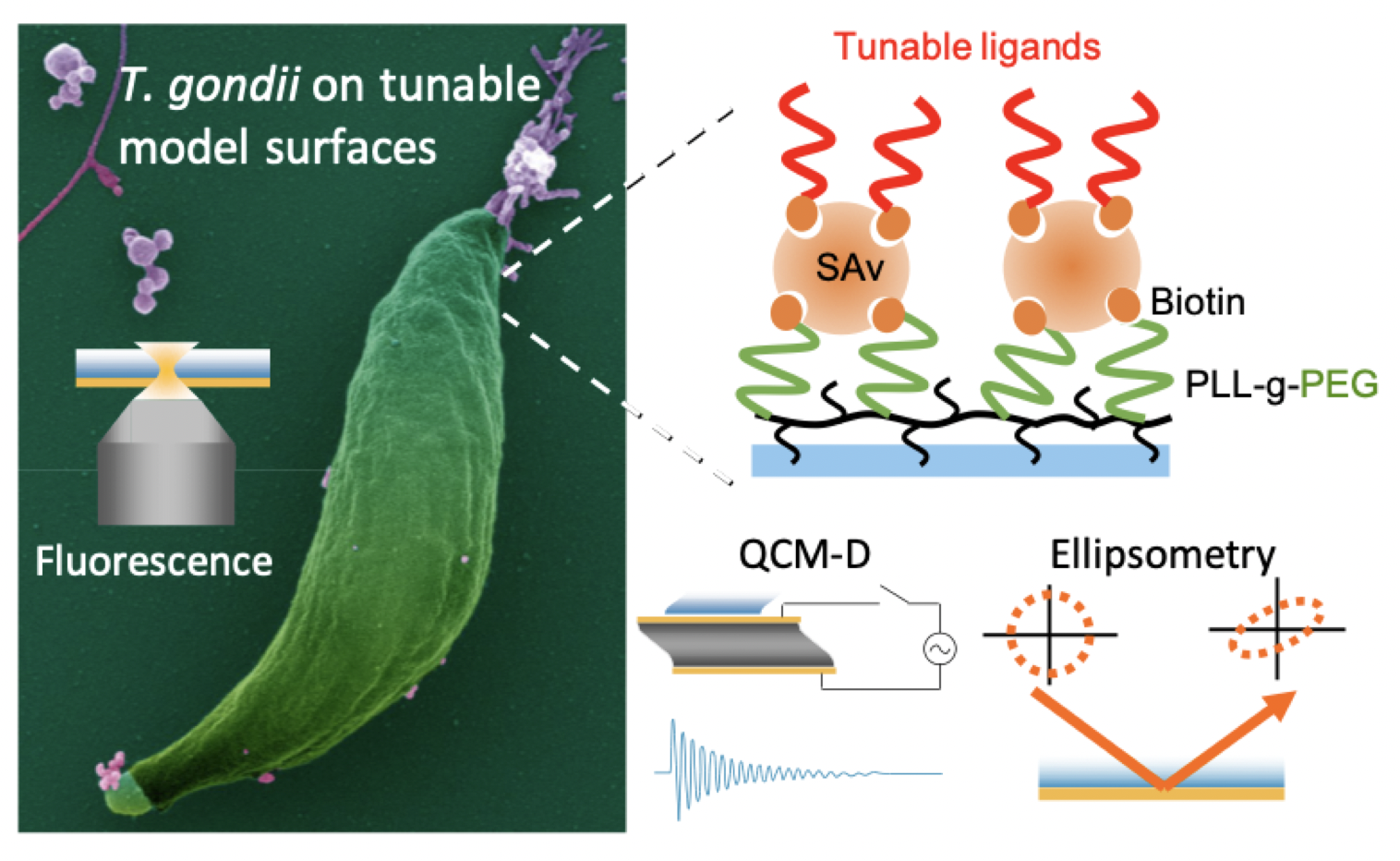
We combine experiments and theory to investigate how the selectivity of multivalent interactions is regulated at biointerfaces and how it is coupled to binding kinetics (collab. R. Richter, UoL and T. Curk, JHU; PhD B. Chabaud). In parallel, we extend surface-design strategies developed on artificial model systems to biomimetic platforms that enable the study of multivalent interactions under biologically relevant conditions. Using this approach, we identified biomolecular ligands that promote Toxoplasma parasite motility, and we are now investigating how additional parameters, such as ligand density and lateral mobility, influence these interactions (ANR PRC “MiniToxoAd” 2023-26, collab. I. Tardieux, IAB; postdoc Q. Gaudillat). More recently, we have also extended our work to soft, deformable biomimetic interfaces. By combining controlled surface chemistry with quantitative biophysical measurements, we investigate how deformability and interfacial dynamics regulate multivalent adhesion, binding kinetics, and cellular responses (ANR PRC "SofA" 2025-29, IdEx IRGA "CASIMIR" 2024-27, collab. D. Débarre, LIPHY; PhD W. Chiang).
- L. Vigetti, B. Touquet, D. Debarre, T. Rose, L. Bureau, D. Abdallah, G. V. Dubacheva, I. Tardieux, Nature Microbiology 9, 3148-3164 (2024)
- G. V. Dubacheva, T. Curk and R. P. Richter, Acc. Chem. Res. 56, 729-739 (2023)
- T. Curk, G. V. Dubacheva, A. R. Brisson and R. P. Richter, J. Am. Chem. Soc., 144, 17346-17350 (2022)
Curriculum vitae
Expertise:
Surface chemistry, physico-chemical characterization, supramolecular interactions, multivalent assembly
Current position:
2022 Habilitation à Diriger des Recherches, Université Grenoble Alpes
since 2015 CNRS researcher (CRCN, section 13), in 2019 changed affectation from PPSM (ENS Paris-Saclay) to DCM (UGA), where I joined the I2BM group
Collective responsibilities:
- Elected member of the CNRS National Committee, section 13 (2021-2025)
- Representative "Website & Communication" for I2BM, DCM, UGA (since 2026)
- Representative "Open Science & HAL" for DCM, UGA (since 2022)
Previous post-doc positions:
2015 ENS Paris (France), Temperature-switchable nano-capsules (C. Tribet)
2012-2014 CIC biomaGUNE (Spain), Multivalent binding to surfaces (R. Richter)
2011 ISM, Université Bordeaux 1 (France), Photo-active monolayers (D. Bassani)
2009-2010 DCM, UGA (France), Redox-switchable supramolecular films (I2BM)
Education:
Lomonosov Moscow State University (Russia), Chemistry Department
2005-2008 PhD in Physical Chemistry, Electrochemical biosensors (I. Kurochkin)
2000-2005 Graduate studies, M.Sc. in Chemistry
Publications
Selected publications:
1. Submicrometre spatiotemporal characterization of the Toxoplasma adhesion strategy for gliding motility, L. Vigetti, B. Touquet, D. Debarre, T. Rose, L. Bureau, D. Abdallah, G. V. Dubacheva* & I. Tardieux*, Nat. Microbiol., 2024 https://doi.org/10.1038/s41564-024-01818-3
2. Influence of surface chemistry on host/guest interactions: model study on redox-sensitive β-cyclodextrin/ferrocene complexes, B. Chabaud, H. Bonnet, R. Lartia, A. Van Der Heyden, R. Auzély-Velty, D. Boturyn, L. Coche-Guérente, G. V. Dubacheva*, Langmuir, 40, 4646–4660, 2024
3. Determinants of superselectivity – practical concepts for application in biology and medicine, G. V. Dubacheva, T. Curk and R. P. Richter*, Acc. Chem. Res. 56, 729-739, 2023
4. Controlling superselectivity of multivalent interactions with cofactors and competitors, T. Curk*, G. V. Dubacheva, A. R. Brisson and R. P. Richter*, J. Am. Chem. Soc., 144, 17346-17350, 2022
5. Thermoresponsive Fluorescence Switches Based on Au@pNIPAM Nanoparticles, D. Kamzabek, B. Le Dé, L. Coche-Guérente, F. Miomandre and G. V. Dubacheva*, Langmuir, 37, 10971–10978, 2021
6. Multivalent recognition at fluid surfaces: the interplay of receptor clustering and superselectivity, G. V. Dubacheva*, T. Curk, D. Frenkel, R. P. Richter*, J. Am. Chem. Soc., 141, 2577−2588, 2019
7. Bacteria-based production of thiol-clickable genetically encoded lipid nanovesicles, J. Royes, O. Ilioaia, Q. Lubart, F. Angius, G. V. Dubacheva, M. Bally, B. Miroux*, C. Tribet*, Angew. Chem. Int. Ed., 131, 7473−7477, 2019
8. Combined scanning electrochemical and fluorescence microscopies using a tetrazine as a single redox and luminescent (electrofluorochromic) probe. L. Guerret-Legras, J. F. Audibert, G. V. Dubacheva and F. Miomandre*, Chem. Sci., 9, 5897-5905, inside cover, 2018
9. Controlling Multivalent Binding through Surface Chemistry: Model Study on Streptavidin, G. V. Dubacheva*, C. Araya-Callis, A. Geert Volbeda, M. Fairhead, J. Codée, M. Howarth, and R. P. Richter*, J. Am. Chem. Soc., 139, 4157–4167, 2017
10. Designing multivalent polymers for tunable superselective targeting, G. V. Dubacheva*, T. Curk, R. Auzély-Velty, D. Frenkel, R. P. Richter*, Proc. Natl. Acad. Sci. USA, 112, 5579-84, 2015
11. Superselective targeting using multivalent polymers, G. V. Dubacheva*, T. Curk, B. M. Mognetti, R. Auzély-Velty, D. Frenkel, R. P. Richter*, J. Am. Chem. Soc., 136, 1722–1725, 2014
Informations complémentaires
Students under supervision:
- Bruno Espuche (postdoc, 100%, DCM, 2025-26, ANR "UtHeal")
- Quentin Gaudillat (postdoc, 100%, DCM, 2025-26, ANR "MiniToxoAd")
- Baptiste Chabaud (PhD & postdoc, 100%, DCM, 2022-26, ANR "SupraSwitch")
- Furhan Abdul Rezak (PhD, 50%, IAB/DCM, 2023-26, ANR "Sequoia")
- Wanchung Chiang (PhD, 50%, LIPHY/DCM, 2024-27, IRGA "CASIMIR")
- Emily Ezewudo (M2, 100%, DCM, 2026, ANR "MiniToxoAd")
- Imprimer
- Partager
- Partager sur Facebook
- Partager sur LinkedIn